

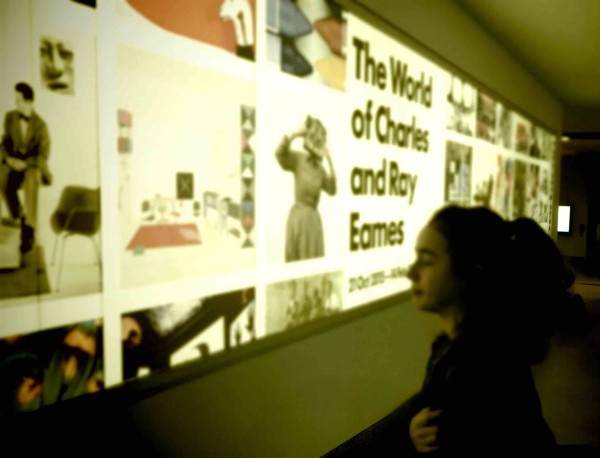
Take a seat.
In this case, a quintessential seat of the 20th century. That’s the way into the The World of Charles and Ray Eames, a current design exhibition at the Barbican – about the couple who created the iconic plastic DSW chair, the moulded plywood chair, the lounge chair and ottoman, all of which still feature like furniture supermodels in modern home magazines, in films and on television, even showing up in Don Draper’s boardroom.
We know about and love the chairs. When I was young, my uncle’s LCW (Lounge Chair Wood) sat in one corner of his sitting room as an object of adoration. Whenever we visited I would perch on the ottoman or scoot back into its sinuous depths.

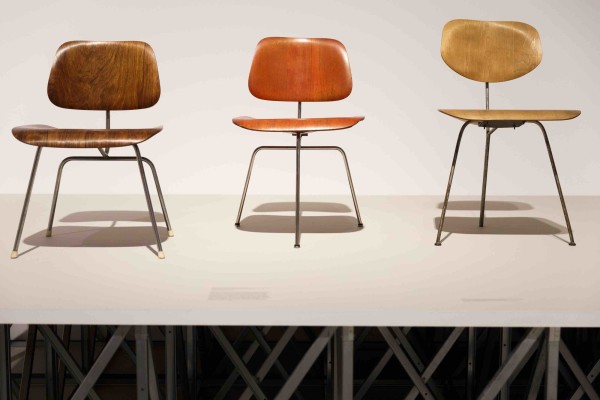
“They’re like most chairs,” my daughter remarked as we walked through the show, on until 14 February 2016. In her view, practically all chairs are some form of Eames chairs; the details and concepts that are apparent in the original designs endure and are all around us. They’ve spawned countless imitations.
But the chairs are merely a foothold into an exhibit that showcases an entire way of thinking about the objects we live with, the space around us, how we live and the world itself.


Learning about the Eames philosophies
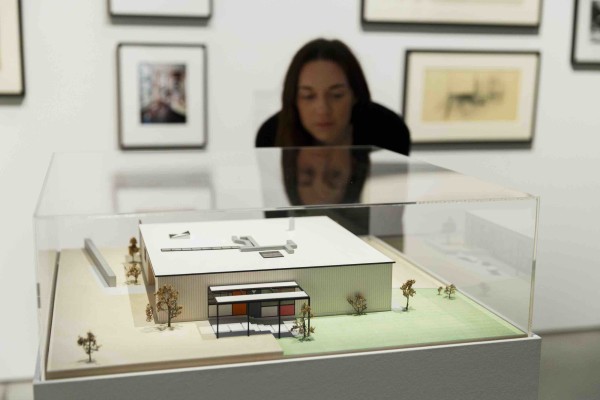
What you discover as you walk through the show – which features photographs from the Eames Office, graphic designs that Ray did for Art & Architecture magazine, results of their experimentations with materials and manufacturing, models of houses they designed, and more – is how strongly the Eames’ philosophies ran through all the work they did, ushering in concepts of living and design that we still embrace today.
These include themes such as “truth to materials”, a focus on the “attitude” toward the space and objects with which one lives, and appreciation of how the useful and beautiful enhances life. The style of modernism that the two developed with collaborators such as Harry Bertoia and Eero Saarinen still convey modernity and chic today.
There are surprises in the exhibition as well. I didn’t know Charles Eames developed splints and stretchers for the US Navy during WWII (they look like elegant art pieces). Letters between the couple, including Charles’s proposal, and the story of their relationship shed light on their longterm collaboration (she was his student, he was married when they met). Later, their interest in education lead to innovative exhibitions and helped popularize science.

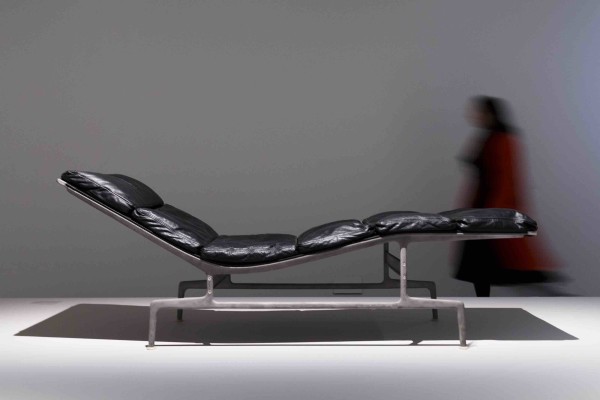
A timeline puts their lives and work in context – Eames milestones are charted alongside the seismic events of the 20th century – Rosa Park’s famous bus ride, the assassinations of John F Kennedy and Martin Luther King… They marry the year of the Pearl Harbour attack.
Family-friendly factor
Anybody who likes to draw, design, build or create will enjoy this exhibition. There is so much with which to interact: audio and video to listen to and watch, small-scale model houses to admire, furniture, shapes and objects to view. The items on display are vintage works, which means no touching. If you have younger kids with curious hands, you’ll need to be constantly vigilant.
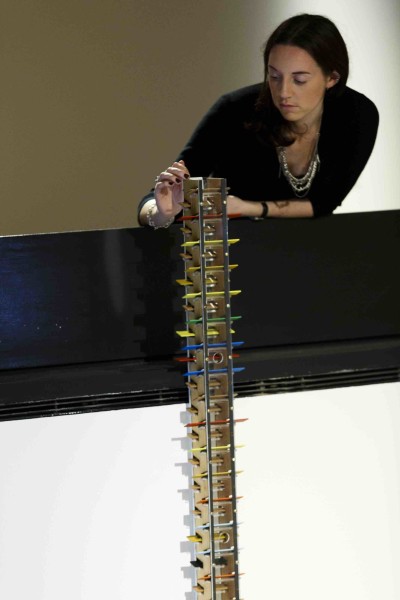
In one room stands a musical tower, a gravity-powered xylophone two stories tall, developed in the 1950s. At intervals a staff member takes a metal ball, goes to the upper level and drops it so we can all listen as it pings the metal plates on its descent.
“Is it a marble run?” one dad asks his son, prompting his child to muse thoughtfully.
At another point in the exhibition, a dark-haired dad crouches down with his 10-year-old, talking about the curved shape of a fiberglass chair.
“I think it’s made of wood,” the boy asserted.
“Think how difficult it would be to make that curved shape from one piece of wood…” the father responded.
Of course, in other areas of the show, there are undulating, supple shapes that are bent out of plywood. Walking through The World of Charles and Ray Eames you get a real grasp on how innovative it was to conceive these objects, how different they were from what came before, how thrillingly fresh the Eames’s philosophies were.
Charles and Ray made these objects and ideas come to life. Now it’s hard to imagine our world without them.
The details:
The World of Charles and Ray Eames
Through 14 February 2016
Barbican Centre
Silk Street
London EC2Y 8DS
http://www.barbican.org.uk/
Disclosure: Jenography was provided press tickets to this show. All opinions are my own.

That sounds amazing – how wonderful to find out more about such an icon. It’s so familiar now, it’s almost hard to imagine a time before, how revolutionary the design would have been.
I really do suggest going. All the ideas and innovation are incredibly inspiring. It makes me want to design my own chair.
Sounds Look Like Amazing,Really Fabulous Written,thanks for sharing us..
Thanks for your comment!
We have a red leather Eames-style chair (not a proper one!) in our living room and I am so glad we bought it some years ago as a well-designed chair is beautiful, comfy and a work or art. Fascinating exhibition.
Trish, red leather? I had no idea that that’s how you roll. I bet it’s a centrepiece for the entire room.